
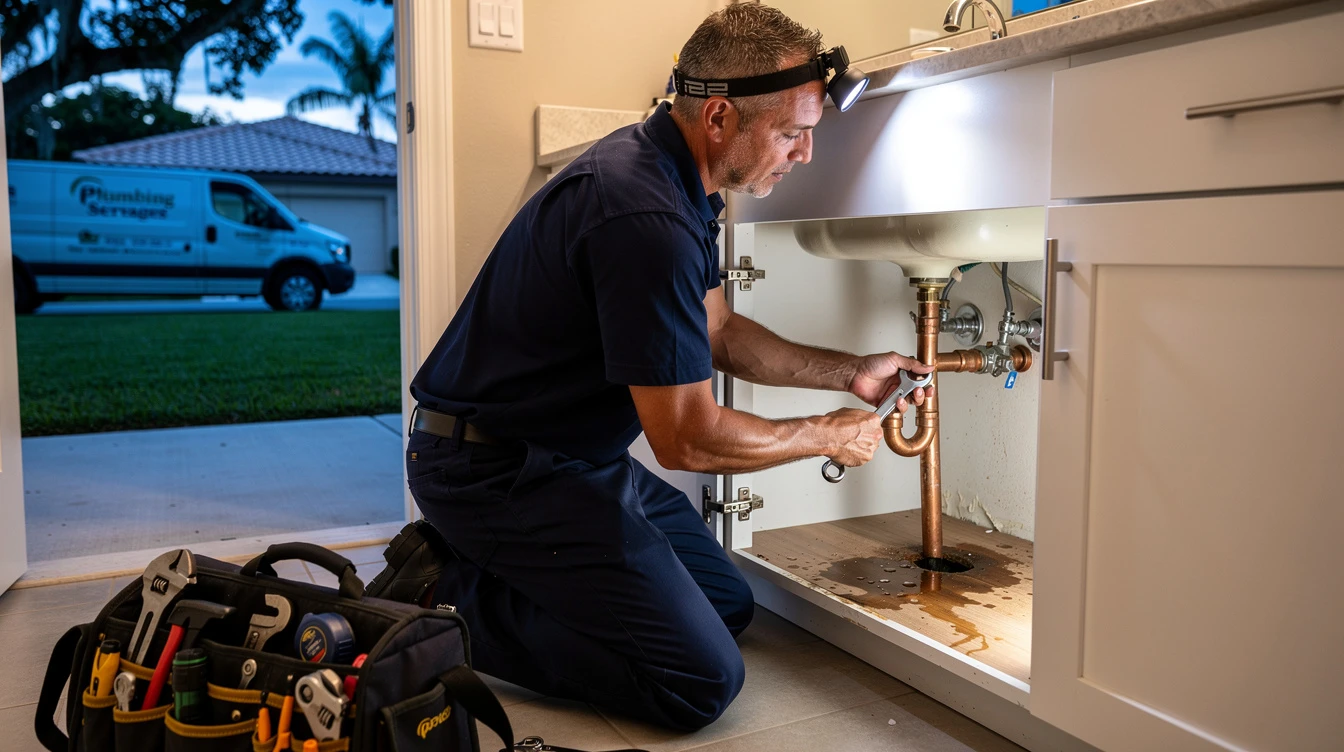
Never WaitFor Hot Water
A tank that won't fire, water that turns rusty, or a slow puddle under the closet door usually means the same thing: something inside your heater has finally worn out. Our team gets to the source fast and puts real hot water back in your pipes, often before dinner.
Six warning signs homeowners call us about
Every Tap Runs Cold
A dead electric element or an extinguished pilot on a gas unit stops heat production completely. Before we recommend a new tank, we check the actual part that failed.
Brownish Or Metallic Water
Once the anode rod is spent, the steel tank starts rusting from within. A rod swap while it's still early can add years back to a tank you'd otherwise be replacing.
Banging Or Knocking Sounds
South Florida's mineral-heavy water leaves a crust of sediment on the tank floor. Steam pushing through that layer is what causes the knocking, and it quietly wastes energy too.
A Damp Spot Near The Tank
A drip from the pressure relief valve is a quick fix. Moisture coming from the tank body itself is a different story and usually means it's time to replace, not patch.
Hot Water Doesn't Last
If the shower turns lukewarm halfway through, a cracked dip tube, a failed lower element, or simply a tank too small for the household is often the culprit.
Tankless Displaying An Error
A blinking fault code on a tankless unit is frequently scale buildup on the heat exchanger, a natural byproduct of our coastal hard water. A descale flush typically resolves it.
How each visit unfolds
Find The Actual Failure
We check the thermostat, elements or burner assembly, gas supply, thermocouple, and voltage first. A surprising number of "dead" heaters just need one small part.
Check The Tank Itself
We pull the anode rod to read its condition, drain a sample to gauge sediment, and inspect the tank seams for rust. That evidence drives an honest repair-or-replace call.
Fix It Or Size A New One
Repairs are usually handled from stock on the truck that day. If replacement is the right move, we help you pick a properly sized tank or discuss a tankless upgrade.
Handle The Paperwork
Replacements require a permit in most South Florida cities. We file it, install to current code with a proper expansion tank and shutoff, and schedule the inspection ourselves.
Test Before We Leave
Whether repaired or brand new, we flush out sediment, purge air from the lines, relight or re-energize the unit, and confirm temperature and recovery at the faucet.
Warranty On Paper
You leave with written parts-and-labor coverage and a plain reminder about annual flushing, the one habit that keeps heaters alive longer in our water conditions.
What actually drives the cost
No two water heater calls are identical, so we skip the guessing game. These are the real variables that move a quote up or down, and we walk through every one of them with you on site before any work begins.
- Simple repair versus full swap
- Tank size needed for your household
- Gas or electric fuel source
- Conventional tank versus tankless upgrade
- City permit and inspection costs
- Bringing an older install up to code
- Adding an expansion tank or new shutoff
- How tight the closet or attic access is
- How much sediment has built up
- Gas line or venting changes for tankless
Choosing the right unit for your home
Warm groundwater and mineral-heavy tap water both play into this decision more than people expect. Here's an honest breakdown before you decide.
- Standard tanks cost less to buy and repair, and a 40 or 50-gallon unit handles most households without issue.
- Faster recovery is a side benefit locally: our warmer groundwater helps tanks reheat quicker than they would in a colder climate.
- Tankless gives you continuous hot water and back a closet, but it demands yearly descaling to fight our hard tap water.
- On efficiency: tankless cuts standby losses, while a maintained conventional tank still runs efficiently for many years.
- Switching over may call for a bigger gas line or new venting. We scope that plainly before we ever suggest it.
Rolling out from Deerfield Beach across three counties
Broward
- Deerfield Beach
- Fort Lauderdale
- Pompano Beach
- Coral Springs
- Coconut Creek
- Davie
Miami-Dade
- Miami
- Aventura
- Hialeah
- Miami Beach
- Doral
- Kendall
Palm Beach
- Boca Raton
- Delray Beach
- Boynton Beach
- West Palm Beach
- Lake Worth
- Wellington
What homeowners are telling us
"Our tank started leaking the night before guests arrived. They showed up early, walked me through what had failed, and had a new 50-gallon unit permitted and running before noon. Clean job all around."
"I assumed we needed a whole new heater, but the technician found one bad element and swapped it in under an hour. He could have upsold me and didn't. He also flushed out sediment I had no idea was there."
"We converted to tankless and they managed the permit and inspection from start to finish, including a gas line upgrade they explained clearly before we signed off. Endless hot water and no bulky tank now."
"Rusty hot water had us worried something bigger was wrong. Turned out the anode rod was gone. They swapped it, flushed the tank, and left a note to flush yearly going forward. No pressure to replace anything."
Water Heater FAQ
Is it cheaper to repair or replace my heater?
It comes down to what's actually broken and how old the tank is. A failed element, thermostat, thermocouple, or relief valve is worth fixing on a tank that's still structurally sound. Once the anode rod is fully used up and the steel is corroding, or the tank is weeping from a seam, replacing it is the smarter spend. We check the anode and inspect for rust on the first visit so the recommendation is grounded in what we actually see, not a guess.
Why do water heaters seem to wear out fast here?
Our tap water carries a higher mineral load than a lot of the country, and that mineral content builds up as sediment inside the tank faster than you'd think. That sediment layer accelerates corrosion and cuts efficiency at the same time. Flushing the tank once a year, and replacing the anode rod when it's spent, is the single biggest thing you can do to slow that process down. Tankless units need the same attention through regular descaling.
Do I actually need a permit for a new heater?
In most of the cities we serve across Broward, Palm Beach, and Miami-Dade, yes. A replacement requires a permit and a follow-up inspection confirming it meets current code, which typically means a thermal expansion tank, a proper shutoff, and correct venting or strapping. We file the permit, install to code, and coordinate the inspection ourselves so nothing falls back on you. Skipping this step can complicate an insurance claim or a future home sale.
Does a tankless unit make sense for my home?
If continuous hot water and reclaiming closet space matter to you, and you don't mind an annual descale to protect it from our hard water, tankless is a strong choice. The trade-off is upfront work: many gas units need a larger supply line and updated venting to run properly. For a household that's happy with a well-sized 40 or 50-gallon tank, staying conventional and keeping up with flushes is often the more budget-friendly path. We'll lay out both options honestly and let you weigh it.
Can this get fixed today?
Most repair calls wrap up the same day because our trucks stock common elements, thermostats, thermocouples, valves, and anode rods. Standard tank replacements are frequently finished same-day too. A tankless conversion or a job that needs gas line or venting work may take a bit longer to permit and install correctly. Give us a call and we'll be straight with you about timing for your specific situation.
Request Service
Let's get your hot water flowing again
Whether it's a quick part swap, an anode rod and flush, or a full permitted replacement, our licensed team is ready across Broward, Miami-Dade, and Palm Beach counties. We diagnose before we quote, and every job carries a written warranty. CFC1433655.
Call (754) 232-7614